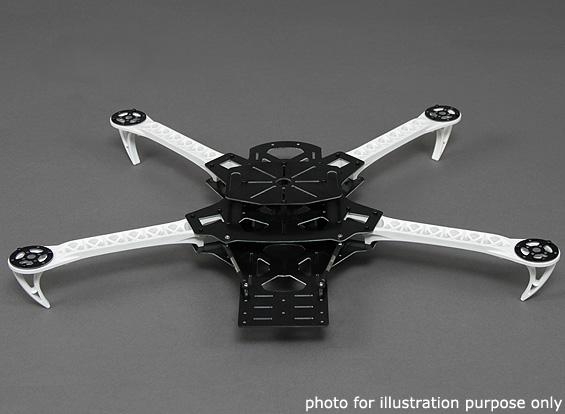
Now that we are back from Florida and parts have arrived, it is time to start the new build. I salvaged whatever I could from the Flying Flowerpot (may it rest in peace). Two motors, the four speed controls, battery, flight control, receiver, and camera were all salvageable. However, I decided to replace some of these parts and to change the configuration of the quadcopter to "Dead Cat" - a non-square quad setup with more room for cameras. See the picture below for the basic setup, not fully assembled.

The other changes that I plan to make are:

- New flight control system (Pixhawk) with more accurate GPS (LEA-6H). I bought the genuine 3DR versions instead of the Chinese clones to ensure quality. My old APM 2.6 system was a Chinese clone and had limitations and unknown quality.
- New receiver (Spektrum AR610). This receiver is highly regarded compared to the Orange R615X, which has rumors of range issues. New Spektrum DX6i transmitter.
- Use of a PCB as a frame to distribute battery power, bought from Hobbyking.
- Dead Cat configuration using a conversion kit from Hobbyking. I made a mistake and assumed that all I needed was the previously mentioned SK450 Dead Cat PCB, but it turns out that you need this plus the Dead Cat conversion kit.
- Full monitoring of power by the control system. This was included with the Pixhawk.
- A proper cover instead of a flower pot, sourced from Quadrysteria.com.
- Receiver power from the Pixhawk or separate UBEC, not from the ESC's. This should be higher quality power with less interference.
- Use of loctite on all screws to reduce the chance of loosening with vibration.
- Carbon fiber props.
The new control and radio system are shown below.